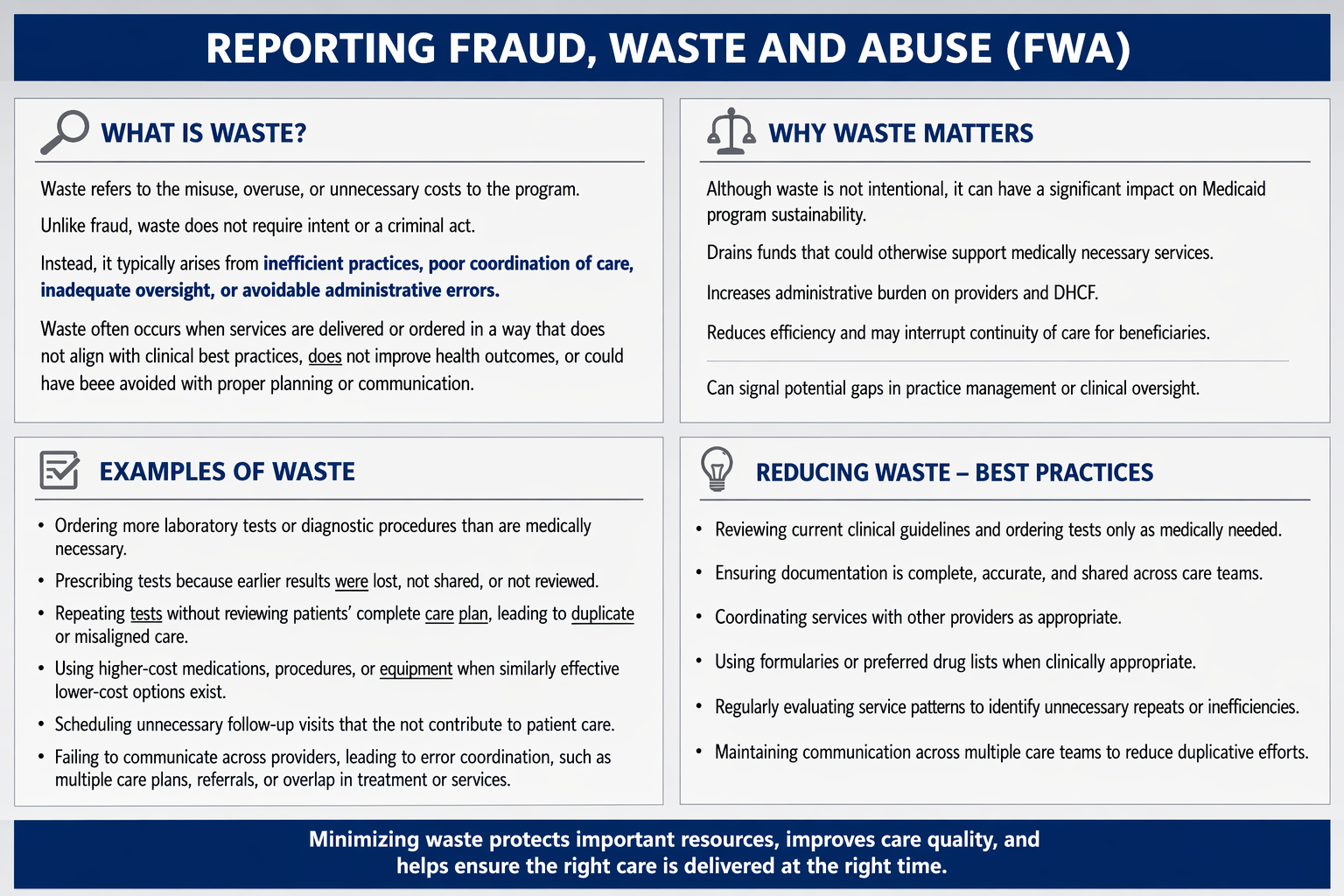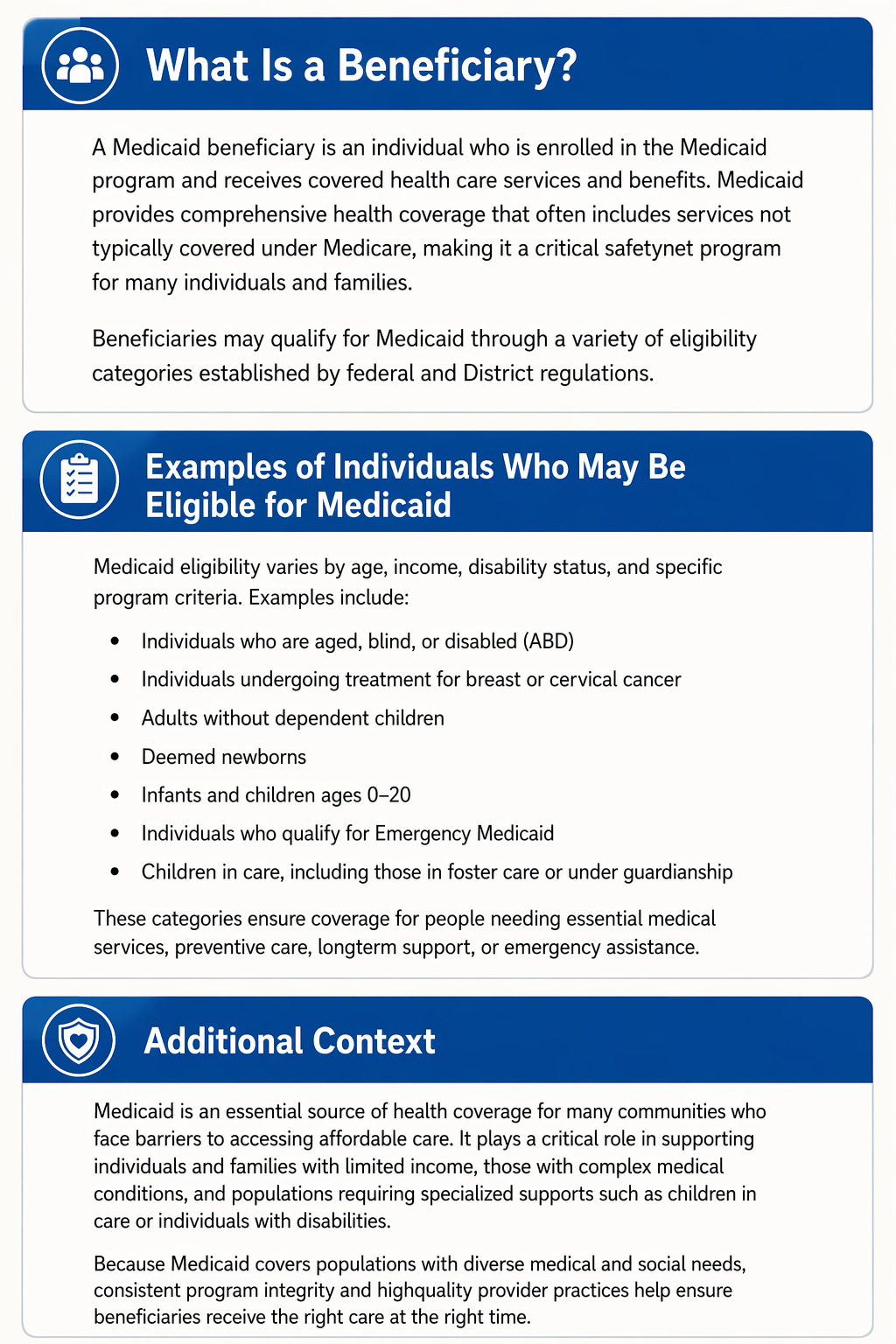


DHCF’s Role in Preventing and Investigating Fraud, Waste, and AbuseThe Department of Health Care Finance (DHCF) conducts activities focused on preventing, detecting, and investigating alleged provider or recipient fraud, waste, and abuse within the Medicaid program. By identifying and addressing these issues, DHCF helps ensure that Medicaid dollars are directed toward essential programs and medically necessary services.
Reporting Suspected Fraud, Waste, or Abuse
When submitting information about suspected fraud, waste, or abuse, please provide as much detail as possible—specifically the who, what, where, when, and why. This information supports timely and accurate review. If available, include:
A clear description of the suspected wrongful or inappropriate act (with as many details as possible).
The name of the person(s) involved.
The workplace or affiliation of the individual(s).
The date and time the incident occurred.
The location where the incident occurred.
The reason you believe the act is improper or inappropriate.
The name, telephone number, and address of anyone who can corroborate or provide additional information.
How to Report Fraud, Waste, and Abuse
You may report concerns using the link below or by contacting DHCF directly:
Click here to report Fraud and Abuse
Department of Health Care Finance
Division of Program Integrity
441 Fourth Street, NW
Washington, D.C. 20001
Hotline: 1‑877‑632‑2873
Online Reporting: https://dhcf.i-sight.com/external/case/new
Authority of Program Integrity to Investigate and Review Medicaid Activities
Federal and District laws require the identification, prevention, and recovery of improper Medicaid payments through audits, investigations, and ongoing program integrity activities. The citations and references below outline key authorities supporting DHCF’s Program Integrity functions. This list is informational and not exhaustive.
Federal Authorities
Federal Executive Order 13520 (11/20/2009): Emphasizes reducing improper payments and strengthening program accountability. https://obamawhitehouse.archives.gov/the-press-office/executive-order-reducing-improper-payments
Improper Payments Information Act of 2002: Requires federal agencies and programs, including Medicaid, to measure, report, and reduce improper payments. https://www.justice.gov/archive/ag/annualreports/pr2007/sect1/p20.pdf
Presidential Memorandum on Finding and Recapturing Improper Payments (3/10/2010): Directs agencies to intensify efforts to detect and recover improper payments. https://obamawhitehouse.archives.gov/the-press-office/presidential-memorandum-regarding-finding-and-recapturing-improper-payments
Key Federal Regulations (Code of Federal Regulations) https://www.govinfo.gov/app/collection/cfr/
42 CFR 431.10: Establishes the designated state agency responsible for administering the Medicaid program.
42 CFR 447.202: Requires audits of Medicaid payments for services.
42 CFR 455: Defines Medicaid program integrity requirements, including fraud and abuse detection, investigation, and referral.
42 CFR 438: Outlines managed care program integrity requirements.
42 CFR 456: Covers utilization control requirements, including medical necessity and service appropriateness reviews.
42 CFR 1001: Provides guidance related to program integrity and exclusion authorities.
District of Columbia Regulations https://www.dcregs.dc.gov/Common/DCMR/TitleListPage.aspx?AgencyID=1
Title 29, Chapter 29‑13 – Medicaid Program Administrative Procedures:
http://dcregs.dc.gov/Gateway/ChapterHome.aspx?ChapterNumber=29-13
Title 29, Chapter 29‑19 – Home and Community-Based Services Waiver for Individuals with Intellectual and Developmental Disabilities:
http://dcregs.dc.gov/Gateway/ChapterHome.aspx?ChapterNumber=29-19
Federal Statutory Authority
Section 1902 of the Social Security Act [42 U.S.C. 1396a] – State Plans for Medical Assistance:
Requires states to maintain systems to detect and address fraud, waste, and abuse in Medicaid.
https://www.gpo.gov/fdsys/search/pagedetails.action?granuleId=USCODE-2010-title42-chap7-subchapXIX-sec1396a&packageId=USCODE-2010-title42
What Is Fraud?
Fraud is an intentional act of deception or misrepresentation carried out with the knowledge that it could result in an unauthorized benefit to an individual or another party. Fraud includes any act that meets the definition of fraud under applicable federal or state law.
In the Medicaid program, fraud is not accidental, it requires intent, meaning the person knowingly acted to deceive, conceal, or misrepresent information for financial gain.
Examples of Provider Fraud
Below are common examples of fraudulent provider behavior that may occur in healthcare or Medicaid settings:
Billing for services that were never provided
Billing for supplies or equipment that the beneficiary never received
Billing for higher‑level or more expensive services than those actually performed (upcoding)
Billing multiple times for the same service (duplicate billing)
Submitting claims for services provided to individuals who are deceased
Unbundling services – billing separately for services that should be billed together to increase reimbursement
Performing or billing for medically unnecessary services
Having unlicensed or unauthorized individuals perform services and billing as if a licensed provider performed them
Falsifying documentation, such as progress notes, medical charts, prior authorizations, caretaker timesheets, orders, or visit logs
Overprescribing medications without clinical justification
Dispensing generic medications but billing Medicaid for brand‑name drugs
Offering or accepting anything of value (cash, gifts, meals, services, or favors) in exchange for referrals or to influence the use of certain services or equipment (kickbacks)